
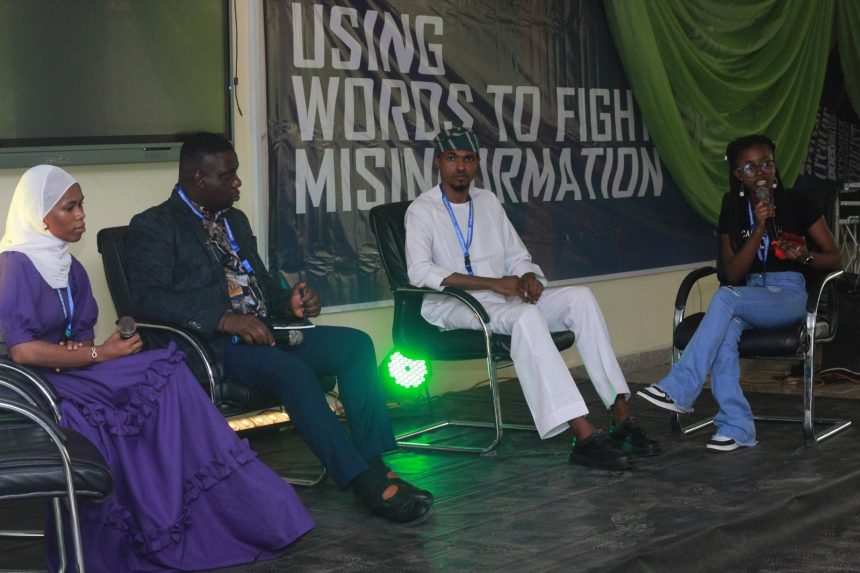
The maiden edition of Truth in Verse, a poetry festival focused on Media and Information Literacy (MIL) and organised by Roundcheck, was held on December 12, 2025.
The event examined how poetry, education, journalism, and creative expression can intersect to promote critical engagement with media and information.
The festival showcased the power of spoken-word poetry in communicating MIL messages across themes such as gender, artificial intelligence, human rights, and elections.
In his opening address, Roundcheck’s Executive Director, Caleb Ijioma, explained that Truth in Verse emerged from the convergence of his passion for spoken-word poetry and his professional work in fact-checking.
According to him, the festival was conceived as a space where poetry, storytelling, workshops, and conversations could merge to encourage critical thinking and responsible media engagement.
He highlighted Nigeria’s large and youthful online population, noting that although millions engage with digital content daily, only a small percentage possess the skills needed to critically evaluate the information they encounter.
He further described spoken-word poetry as an effective medium for reaching young people, as it delivers messages in ways that are relatable, memorable, and easily shared.
“ Truth in Verse offers more than a traditional learning experience. It invites young people to feel, to question, and to grow.
Through this festival, we raised awareness about misinformation, critical thinking skills, built collaboration between poets, journalists, and educators, and produced resources that will last beyond today,” he said.
Motunrayo Joel, Deputy Editor at Africa Check, emphasised the importance of young people developing the habit of verifying information before sharing it.
She explained that media consumers must learn to look beyond personal biases and properly evaluate media messages before accepting or circulating them.
The festival featured several panel sessions, during which experts shared insights on how newsrooms can strengthen Media and Information Literacy and adopt strategies to promote the practice across Africa.
Senior Reporter at The Nation newspaper, Alao Abiodun, stressed that fact-checking should begin at the reporting stage, describing reporters as the first line of defence against misinformation.
He noted that accuracy and credibility must be established before stories reach editors.
UNESCO MIL expert, Dr Olunifesi Suraj, turned attention to the education sector, arguing that Media and Information Literacy must start in the classroom.
He identified the gap between academic training and newsroom practice as a major obstacle to effective verification.
“Students should not graduate without acquiring practical fact-checking and verification skills,” he said, emphasising the need for collaboration between educators, media practitioners, and fact-checking organisations to better prepare students for the realities of modern newsrooms.
Also speaking, Allwell Okpi, Community Manager at Africa Check, addressed newsroom collaboration, observing that although partnerships between newsrooms and fact-checking organisations exist, many lack structure and sustainability.
Allwell stressed the need for more deliberate collaborations that allow fact-checking expertise to flow directly into newsroom operations, noting that news organisations remain powerful platforms for promoting Media and Information Literacy.
Victor Ejechi, Head of Insights at SBM Intelligence, spoke on the role of data and analytics in identifying misinformation trends. He encouraged journalists to become more comfortable working with numbers, describing data as central to verification, especially when reporting on government statistics, budgets, and socio-economic indicators.
Meanwhile, the Founder of Naija Poetry Fest, Godson Osarenren, highlighted the importance of creative platforms in bringing young people together, amplifying advocacy, and encouraging social change.
He noted that consistent creative expression can empower young people to stand for truth and become agents of change within society.
Spoken-word artist Mariam Tijani also underscored poetry’s transformative potential, noting that it has the ability to simplify complex ideas and drive change.
According to her, “poetry cannot just be for expressing feelings, but can be used to advocate change.”
The festival concluded with key recommendations, including the integration of fact-checking and Media and Information Literacy into journalism education, continuous newsroom training on data literacy, and greater use of creative expressions such as poetry and art to advance MIL.
The event also featured a brief introduction to Roundcheck’s new product, Civic Play, a web-based game designed to improve civic awareness and encourage participation.
Project Manager, Ilerioluwa Philips, explained that the game was developed with young Nigerians in mind, allowing them to learn while having fun.
The festival ended with the launch of the Truth in Verse Anthology, which features poems by festival participants.