


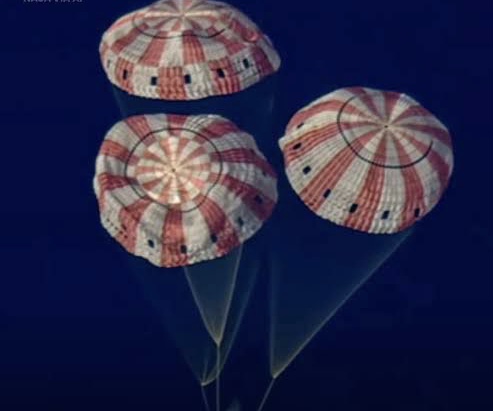
The crew of Artemis II have safely returned to Earth, marking a historic achievement with a successful splashdown after their journey around the Moon, a mission that carried them farther from Earth than any humans have been
The Orion capsule landed in the Pacific Ocean near San Diego, California, on Friday, April 10, 2026, at about 5:07 p.m. local time, which is also 12:07 a.m. Coordinated Universal Time (UTC) concluding the 10-day mission
As Orion re-entered the atmosphere at 400,000 feet, the spacecraft endured a planned yet tense six-minute communications blackout.
The descent lasted approximately 13 minutes before the capsule splashed down in the Pacific Ocean. Parachutes deployed smoothly during the final phase, ensuring a controlled landing.
Commander Reid Wiseman, the team leader, confirmed via radio that the capsule was upright and that all crew members were safe and in good health.
Recovery teams transported the astronauts to the USS John P. Murtha, a U.S. Navy transport ship. From there, the crew will undergo medical evaluations before returning to NASA’s Johnson Space Center in Houston.
Crowds gathered at space centers across the country to witness the historic moment, including enthusiastic spectators at the Air and Space Museum in San Diego, California.
NASA also released breathtaking images captured during the mission. Among the most striking is “Earthset,” a stunning view of the Earth descending behind the Moon’s horizon mirroring the iconic “Earthrise” photograph from Apollo 8.
Another remarkable image shows the Moon completely eclipsing the Sun. The crew experienced this rare total eclipse for nearly 54 minutes as they passed behind the Moon.
From inside Orion, the astronauts watched Earth shrink into a delicate crescent as they journeyed deeper into space.
In total, the Artemis II crew traveled 700,237 miles and reached a peak speed of 24,664 miles per hour, cementing the mission as a landmark moment in human space exploration.