
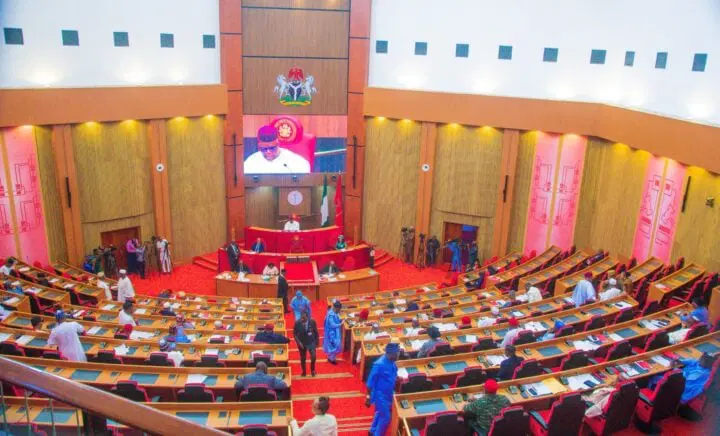
The Senate Committee on Customs and Excise has approved the Nigeria Customs Service’s proposed N11.074 trillion revenue target and N1.235 trillion expenditure estimate for the 2026 fiscal year, expressing confidence that the agency would sustain its reform programme and improve collections despite mounting global economic uncertainties.
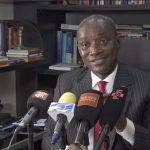
The approval came after the Comptroller-General of Customs, Adewale Adeniyi, defended the Service’s 2026 budget before the committee at the National Assembly, where lawmakers commended the agency for exceeding its 2025 revenue target despite challenges confronting international trade.
Chairman , Senate Committee on Customs and Excise, Isah Jibrin, described the proposed revenue target as ambitious but achievable, urging the Customs leadership to intensify efforts towards meeting the projection.
He also applauded President Bola Tinubu for extending the tenure of the Comptroller-General, saying the decision would enable the Service to consolidate the reforms that is already transforming Customs operations.
The committee chairman noted that the Federal Government’s aggressive investment in infrastructure had increased the demand for internally generated revenue, making Customs one of the most strategic agencies in financing national development.
Responding, the Comptroller-General thanked the President for the confidence reposed in him and expressed appreciation to members of the committee for interrupting their legislative recess to consider the agency’s budget proposal.
Reviewing the Service’s performance in 2025, the Customs boss disclosed that the National Assembly approved a revenue target of N6.584 trillion, but the agency realised N7.277 trillion during the year.
He said the collection exceeds the target by N674.1 billion, representing a 10.24 per cent increase over the approved projection.
According to him, the impressive performance was achieved despite several fiscal policy interventions and global economic disruptions that constrained revenue generation.
Among the major factors he identified are the suspension of excise duty on telecommunications services, delayed implementation of the Green Tax, import duty waivers granted on compressed natural gas (CNG) and electric vehicles, healthcare equipment and industrial raw materials, as well as extensive import duty exemption certificates issued by the Federal Government.
The Comptroller-General also cited the lingering effects of the Russia-Ukraine conflict, which disrupted imports of strategic commodities such as wheat and affected Customs collections.
Although the agency surpassed its revenue target, he disclosed that Customs received only N808.86 billion, representing 71.46 per cent of its approved N1.132 trillion expenditure budget for 2025.
For 2026, he said the Service is projecting total revenue of N11.074 trillion, comprising N5.542 trillion from Federation Account revenue, N1.491 trillion from non-Federation collections, N2.773 trillion from Import VAT and N1.266 trillion from the four per cent Free-on-Board (FOB) cost of collection.
The Customs boss attributed the projection to the impact of ongoing institutional reforms, including the successful deployment of the indigenous Unified Customs Information System (UCIS), code-named B’Odogwu, enhanced post-clearance audit operations, intelligence-driven anti-smuggling measures and expanded trade facilitation initiatives.
He added that the Presidential Enabling Business Environment Council (PEBEC) recently rated the Nigeria Customs Service as the country’s most improved government agency in trade facilitation and ease of doing business.
Despite the optimistic outlook, the Comptroller-General cautioned that developments in the global economy could undermine revenue performance.
He disclosed that Customs generated N4.043 trillion in the first half of 2026 against a projected N5.5 trillion, blaming the shortfall on geopolitical tensions in the Middle East.
According to him, major challenge confronting the service today is the crisis around the Strait of Hormuz which has disrupted global supply chains
The Customs chief also briefed senators on Nigeria’s implementation of the African Continental Free Trade Area (AfCFTA), saying the Service is collaborating with the AfCFTA Secretariat, the African Development Bank and neighbouring customs administrations to strengthen cross-border trade.
He revealed that Nigerian Customs officials would soon visit Zimbabwe to understudy the joint border management arrangement between Zimbabwe and South Africa with a view to replicating similar systems at Seme and other strategic border posts.
During the budget scrutiny, lawmakers queried the allocation of over N210 billion under “Financial and Miscellaneous Services.”
Providing clarification, the Comptroller-General explained that the expenditure classification was based on the Federal Government’s official Chart of Accounts issued by the Office of the Accountant-General.
He said the category comprised 84 approved expenditure items, including publicity, overseas missions, sports development, annual conferences, recruitment, staff promotions, advocacy programmes, laboratory services and other statutory administrative obligations.
Satisfied with the explanations offered by the Customs management, the committee unanimously approved the agency’s proposed revenue and expenditure estimates for 2026.
Putting the recommendations to a voice vote, Senator Jibrin secured unanimous approval for the N11.074 trillion revenue target and the N1.235 trillion expenditure proposal.
(Editor: Anoyoyo Ogiagboviogie)