

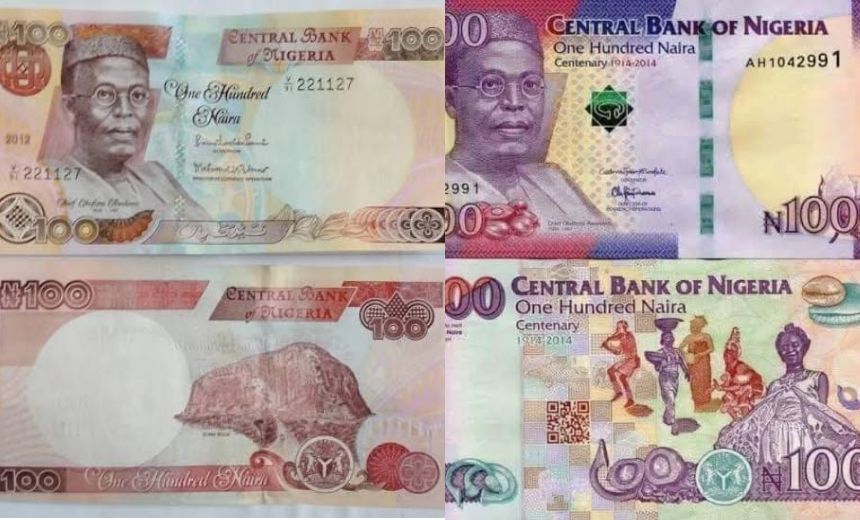
Confusion over the legal status of Nigeria’s standard one hundred naira note has prompted the Central Bank of Nigeria to issue a public clarification, warning that rejecting the banknote is illegal and could attract sanctions under the CBN Act.
The apex bank says both the standard and commemorative one hundred naira notes remain legal tender and must be accepted for all transactions nationwide, stressing that the commemorative note introduced during Nigeria’s centenary celebrations did not replace the existing one hundred naira banknote.
The Central Bank’s clarification comes amid growing confusion in the marketplace, where many Nigerians have reported difficulties using the standard one hundred naira note for everyday transactions.
According to the apex bank, the commemorative one hundred naira note issued to mark Nigeria’s centenary was never intended to replace the existing standard note, as both remain legal tender and must be accepted nationwide.
The Bank warned that rejecting any legally issued banknote violates the provisions of the CBN Act, undermines confidence in the naira and could attract regulatory sanctions against defaulting individuals, businesses and financial institutions.
However, the clarification has generated a wave of reactions on the Bank’s official social media platforms. While some Nigerians welcomed the statement, many claimed they had experienced rejection of the standard one hundred naira note by traders, commercial transport operators and even some banks.
Others argued that the challenge extends beyond the one hundred naira denomination, calling on the apex bank to also clarify the legal status of the five naira, ten naira, twenty naira and fifty naira notes, which they say are increasingly being rejected in parts of the country.
Some respondents also raised concerns over the scarcity of the standard one hundred naira note, urging the CBN to improve its circulation to ease the difficulties faced by commuters, small businesses and consumers who rely heavily on cash transactions.
The mixed reactions underscore broader concerns about cash circulation and public awareness of Nigeria’s currency policy.
Analysts say while the CBN’s clarification addresses the legal status of the one hundred naira note, restoring confidence in the cash economy will require sustained public enlightenment, effective enforcement against unlawful rejection of legal tender, and improved distribution of lower denomination banknotes to support seamless commercial transactions across the country.
(Editor: Anoyoyo Ogiagboviogie)