
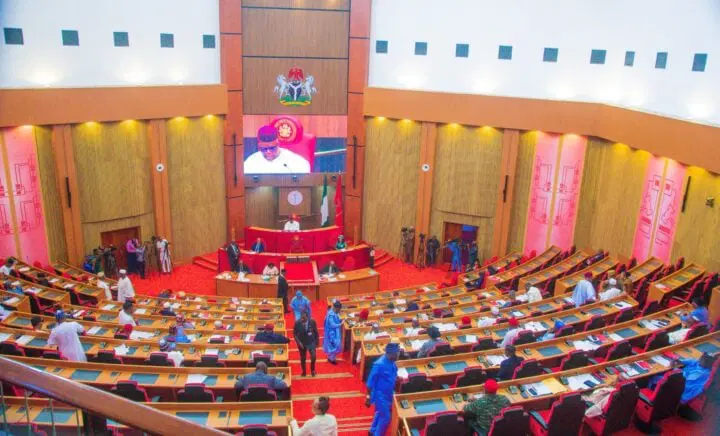
The Senate, through its Committee on Appropriations, has said Nigeria cannot stop borrowing, noting that the country’s debt-service burden remains a major challenge.
The Committee noted that Nigeria is not only servicing the debts of the current administration but also obligations dating back to the military era.
The committee warned that failure to meet these obligations would damage Nigeria’s credit ratings with the World Bank, the International Monetary Fund (IMF), and other global rating agencies.
Chairman Senate Committee on Appropriations,Solomon Olamilekan made this statement during a one-day public hearing and interactive session on the 2026 Appropriation Bill organised by the committee.
He explained that Nigeria’s debt burden is cumulative, adding that the country continues to service accumulated obligations and will remain committed to doing so.
Addressing concerns over the projected N25.1 trillion budget deficit in the 2026 budget,Olamilekan said high debt-to-revenue ratios are a global reality, noting that government revenues are received gradually rather than in lump sums.
He added that revenue projections often differ from actual receipts.
He says While projections may stand at N5trillion, actual inflows could be significantly lower within the fiscal year.
On funding the 2026 budget deficit, the senator said the Federal Government plans to access Eurobonds and international financial markets, while also disposing of certain joint venture (JV) assets
According to him Proceeds from the privatisation of selected federal government assets and properties will also be used to free up revenue for critical obligations.
Olamilekan noted that the era of multiple overlapping budgets has ended, recalling a period when as many as four budgets ran concurrently.
He emphasized that the National Assembly would no longer extend budgets beyond their financial year, with all outstanding liabilities and critical projects captured within the 2026 budget framework.
The committee chairman said he would work to ensure Nigeria exits the envelope budgeting system in favour of a project-based budgeting framework, aimed at clearly defining critical national priorities and delivering measurable results.
He described the 2026 budget as a potential turning point, insisting that all Ministries, Departments, and Agencies (MDAs) benefiting from service-wide votes would be held accountable.
He warned that refusal to appear before the legislature to account for funds utilisation ny any agency would not be tolerated.
He concluded that all MDAs must comply with legislative oversight to ensure the 2026 budget delivers meaningful progress and moves Nigeria forward.
(Editor: Anoyoyo Ogiagboviogie)