

In a comment that has stirred global debate, billionaire tech entrepreneur Elon Musk says the future of the world economy is no longer anchored in the West , but shifting rapidly toward emerging and high-growth markets.
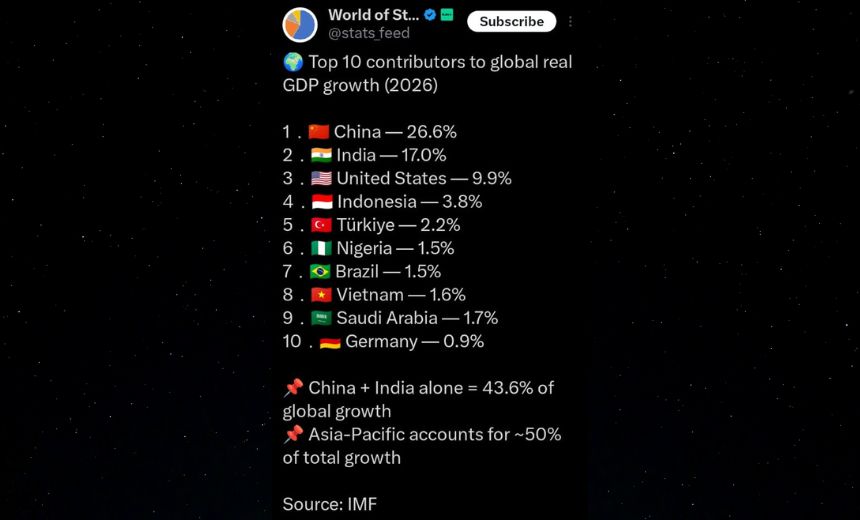
That comment comes as a new global growth report places Nigeria among the top ten contributors to world GDP growth, ranking sixth globally, alongside economic heavyweights like China, India, the United States, and Indonesia.
The data, attributed to the IMF, by world statistics on it’s X handke formerly tweeterb highlights the top 10 contributors to global real GDP growth for 2026. Topping the charts are China and India, which together are projected to drive nearly 44% of the world’s economic expansion.
The report highlighted that Asia-Pacific region now accounts for nearly 60 percent of total global growth, confirming a historic shift in economic gravity.
China and India remain dominant drivers, while Nigeria’s inclusion in the top ten has drawn attention and mixed reactions.
Supporters of the Tinubu administration see it as proof that economic reforms are yielding results, pointing to Nigeria’s growing population, expanding services sector, and role as Africa’s largest economy while some others fimds it hard to describe the disconnect as the gap between macro growth and micro reality , a strong national figures that do not yet translate to improved household welfare.
MUST READ: FAAN Orders Freight Associations to vacate Lagos Cargo Terminal Offices
In contrast, the debate in the United States has taken another turn. Critics there argue that years of outsourcing production to fast-growing countries have weakened the American middle class, fueling calls to bring jobs and manufacturing back home.
Meanwhile, countries like Vietnam, Saudi Arabia, and Germany complete the global top ten, with Germany trailing at just 0.9 percent, reflecting slower growth in mature economies facing aging populations.
The message from the numbers is clear: the world economy is changing shape.
Emerging markets are powering global expansion, while advanced economies slow down. But the bigger question remains, who truly benefits from growth?
For countries like Nigeria, the challenge is no longer just growth , but growth that reaches the individual.
(Editor: Ada Ononye)