

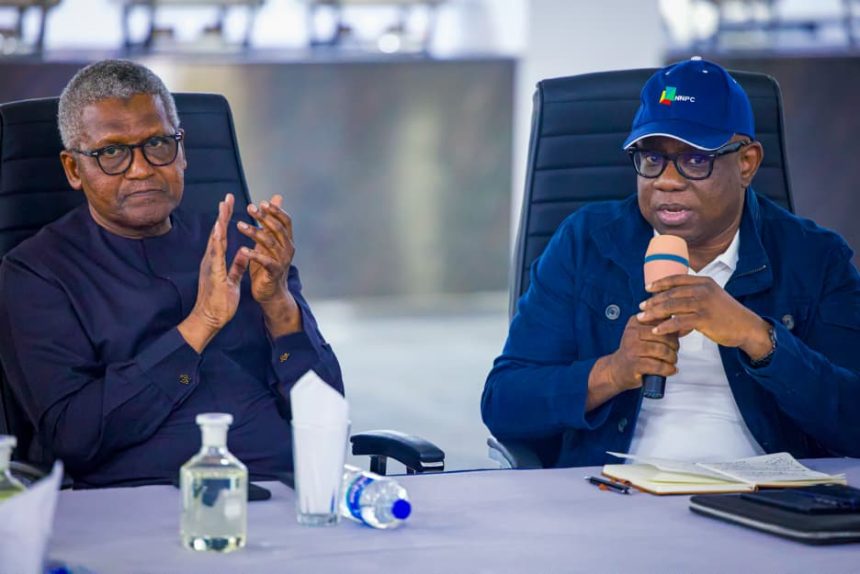
Deputy spokesman of the House of Representatives, Philip Agbese, has commended the deepening collaboration between the Nigerian National Petroleum Company (NNPC) Limited and Dangote Petroleum Refinery & Petrochemicals, describing it as a strategic milestone in Nigeria’s energy sector reforms.
Speaking with journalists in Abuja on Friday, Agbese said the scale and performance of the refinery demonstrate that Nigeria is entering a new phase of industrial execution backed by domestic capacity and coordinated leadership.
“For decades, our national conversation was dominated by refining shortfalls and import dependency.
Today, we are discussing a facility designed for 650,000 barrels per day that is already proving its operational strength.
This will strengthen energy security and restore confidence in Nigeria’s industrial capability,” Agbese said.
He said NNPC’s 7.25 percent equity stake in the refinery places Nigerians in a position of shared benefit and shared responsibility as the project expands its footprint across refining and petrochemicals.
“When the national oil company retains a 7.25 percent stake in a strategic asset of this magnitude, it ensures that national interest is embedded in its success,” he said.
“This is how reform should function. Public institutions must not stand apart from transformative private investments.
They must participate, supervise and align for measurable outcomes.
“I commend Engr. Bashir Bayo Ojulari, the Group CEO of the NNPC, for demonstrating a clear understanding of the vision of President Bola Tinubu on economic restructuring, private sector participation and industrial growth.”
Agbese also pointed to the planned 400,000 metric tonne Linear Alkyl Benzene facility within the industrial complex, saying it signals a deliberate move into higher value manufacturing segments.
“A 400,000 metric tonne petrochemical expansion tells us this is not simply about producing fuel. It is about exploring the full value chain, supplying raw materials for detergents, plastics and manufacturing inputs that currently drain foreign exchange.
These are the numbers that speak to serious industrial ambition,” he said.
The lawmaker stressed that collaboration across upstream production, gas supply, refining and petrochemicals would reduce systemic inefficiencies and strengthen domestic processing capacity.
“Energy reform must be integrated to be effective. When upstream resources, gas development, refining and petrochemical production operate in coordinated fashion, the economy benefits across agriculture, manufacturing and trade.
That is how you stabilise markets and create durable growth,” the legislator said.
Agbese assured Nigerians that the House of Representatives would continue to support policies that promote transparency, regulatory discipline and performance-driven partnerships within the energy sector.
“Nigeria cannot afford fragmented progress. We need structured collaboration backed by accountability and clear deliverables.
If this partnership is sustained with focus and integrity, it will stand as one of the most consequential pillars of our economic renewal,” he added.
“The House of Representatives will continue to stand firmly behind policies that entrench transparency, strengthen regulatory discipline and promote performance-driven partnerships in the energy sector.
“I believe that reform must not only be ambitious in scope; it must be accountable in execution. We will provide the legislative backing necessary to ensure that strategic collaborations deliver measurable value and protect public interest.”