


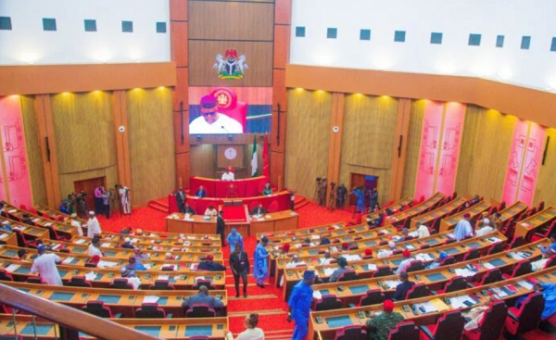
The Senate on Tuesday opposed the Federal Government’s policy of rehabilitating and reintegrating former Boko Haram insurgents into society, arguing that the programme undermines justice for victims of terrorism and weakens the nation’s fight against insecurity.
The Red Chamber also resolved that its leadership should interface with President Bola Tinubu to formally present its concerns over the worsening security situation across the country and urge the President to adopt more decisive measures to tackle terrorism, banditry and kidnapping.
The resolutions follows a motion of urgent national importance sponsored by Senator Abdulaziz Musa Yar’Adua (APC, Katsina Central), Chairman Senate Committee on Army, on the escalating attacks, abductions and killings of serving and retired military personnel across Nigeria.
The motion was prompted by the recent abduction and death of Major-General Rabe Abubakar (Rtd), a former Director of Defence Information, who died in captivity after he was kidnapped alongside his wife by suspected bandits in Katsina State.
Although the motion focused on the deteriorating security situation and the growing attacks on military personnel, senators expanded the debate by proposing tougher measures to combat terrorism, insurgency and banditry.
The most debated proposal came from Senator Joseph Ikpea (APC, Edo Central), seconded by Senator Adams Oshiomhole (APC, Edo North), urging the Federal Government to immediately discontinue the rehabilitation and reintegration of former Boko Haram fighters.
The proposal received support from lawmakers, who argued that reintegrating former or repentant insurgents into society sends the wrong message at a time when innocent Nigerians and security personnel continue to lose their lives to terrorist attacks.
Senators maintained that government efforts should instead focus on delivering justice for victims, strengthening the Armed Forces and providing greater support for security agencies prosecuting the war against terrorism and banditry.
Leading the debate, Senator Yar’Adua expressed concern over the increasingly sophisticated operations of terrorists, bandits and kidnappers, noting that their activities have evolved beyond attacks on communities to the targeted abduction and killing of serving and retired military personnel.
He cited several recent incidents, including the killing of Major General Rabe Abubakar (Rtd) in Katsina State, the murder of Brigadier-General Uwem Harold Udokwere (Rtd) in Abuja, the death of Major Joe Ajayi (Rtd) while in captivity in Kogi State, and the abduction of former Director-General of the National Youth Service Corps, Brigadier-General Maharazu Tsiga (Rtd), in Katsina State.
According to him, the increasing attacks on serving and retired military officers pose a serious threat to national security, undermine the morale of security personnel and erode public confidence in the government’s ability to protect lives and property.
Following deliberations, the Senate observed a minute silence in honour of Major-General Rabe Abubakar (Rtd) and all Nigerians who have lost their lives to terrorism, insurgency, banditry, kidnapping and other violent crimes.
The Senate further resolved that its leadership should immediately engage President Tinubu to convey the concerns of the chamber over the worsening security situation and press for stronger measures to restore peace and security across the country.
Lawmakers also resolved to constitute a delegation to condole with the family of the late Major-General Rabe Abubakar, the Katsina State Government and the Nigerian Army.
The Senate commended the Armed Forces and other security and intelligence agencies for their sacrifices in defending the country and urged them to strengthen intelligence gathering, intelligence sharing, surveillance operations, threat assessment mechanisms and early warning systems to prevent attacks and improve operational response.
It also called for deeper collaboration between security agencies, local communities, traditional institutions and religious leaders to enhance community-based intelligence and strengthen trust-driven security partnerships.
Additionally, the Senate urged the Federal Government to accelerate the deployment of modern security technologies, including unmanned aerial systems, geospatial intelligence capabilities, integrated command and control platforms and advanced communication systems to enhance the fight against terrorism, banditry and kidnapping.
(Editor: Terverr Tyav)