
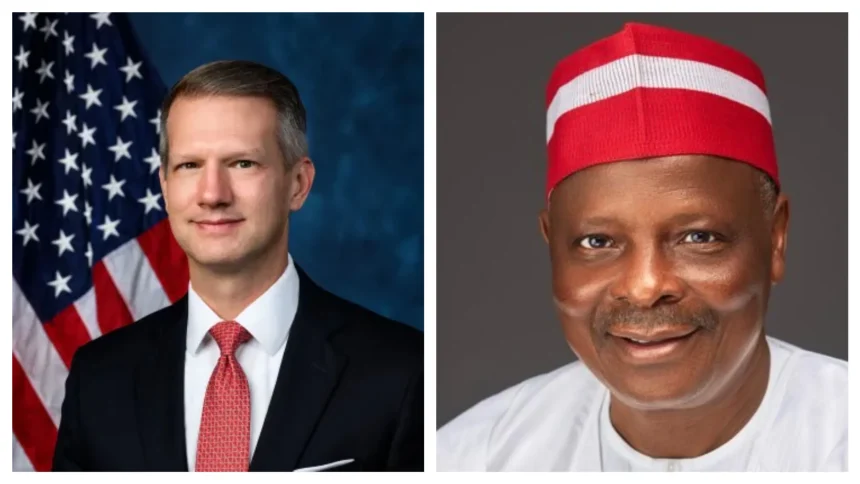
Just three months after Nigeria was redesignated as a Country of Particular Concern (CPC) by President Donald Trump, a bill seeking asset freeze and censor against former Kano Governor, Rabiu Musa Kwankwaso, two Fulani groups among others, is making its way through the United States Congress.
The proposed piece of legislation is introduced by Congressman Riley Moore and co-sponsored by the Chairman of the U.S House of Representatives Subcommittee on Africa, Chris Smith.
It was introduced at Tuesday’s session, and apart from Kwankwaso, who is a former Defence Minister, the Miyetti Allah Cattle Breeders Association of Nigeria and the Miyetti Alla Kautal Hore, are two groups identified as responsible for freedom violations in Nigeria.
Under the “Nigeria Religious Freedom and Accountability Act of 2026 bill”, the U.S Departments of State and that of Treasury would be directed to impose targeted sanctions, under the Global Magnitsky Human Rights Accountability Act on the named individuals and entities, which include visa restrictions.
The proposed legislation also calls on the U.S Secretary of State to determine whether the Fulani militias operating in Nigeria meet the criteria for designation as Foreign Terrorist Organizations under U.S law.
The bill proposes increased humanitarian assistance to affected communities in Nigeria’s Middle Belt.
Also, it recommends that aid be co-funded by the Nigerian government and delivered through trusted faith-based and non-governmental organisations operating in the regions impacted.
Even as Kwankwaso was yet to personally react to this issue, the New Nigeran Peoples Party (NNPP) has queried the proposed bill which it says unfairly targets its national leader.
In a statement, the Party’s National Publicity Secretary, Ladipo Johnson, described the move as contrived and unjust, insisting that Kwankwaso has no record of religious intolerance.
The Party argued that Kano under Kwankwaso as Governor was not the only State to implement Sharia law in Northern Nigeria.
The NNPP also cited Kwankwaso’s past support for inter-faith collaboration, including running with a Christian Vice-presidential candidate in the 2023 election.
The NNPP called on U.S. lawmakers to conduct a thorough and fair investigation to clear what it described as an undue embarrassment of its leader.
The Miyetti Allah Cattle Breeders Association of Nigeria (MACBAN), has said “being tagged a terror-supporting group is unjustified.”
Its President, Othman Ngelzarma told a Nigerian Newspaper, The Authority, that this is the first time in the 42-year history of what he called the “producer association” that any organization or government would be accusing it of associating with terrorism.
Ngelzarma insists that the group is a “peace-loving association which cuts across religious divides,” and have been involved in several moves to keep the peace with several groups and persons across Nigeria.
He added that MACBAN had worked with several local and international NGOs to promote peaceful co-existence between its members and those of other groups.
A meeting of MACBAN’s group will hold soon, he added so as to formally respond to the proposed bill.
In May 2024, terrorism charges against the leader of the Miyetti Allah Kautal Hore, Bello Bodejo were dropped by the Federal Government.
The government had accused Bodejo of unlawfully establishing an ethnic militia group, Kungiya Zaman Lafiya and was arraigned two months earlier.
The bill in the United States Congress has garnered support from dozens of lawmakers.
How far it goes will be seen in the weeks ahead in the Republican- majority lawmaking body.
Last Christmas, the United States carried out airstrikes against suspected Islamic State-linked militants in Northwest Nigeria in coordination with Nigerian authorities, as part of broader counterterrorism and intelligence-sharing efforts.
The Trump administration has also expanded military training support and supplies to Nigerian security forces in recent months.
And on Tuesday, the U.S Africa Command announced that it had deployed a 200-man military team to Nigeria.
Editor: Ken Eseni