
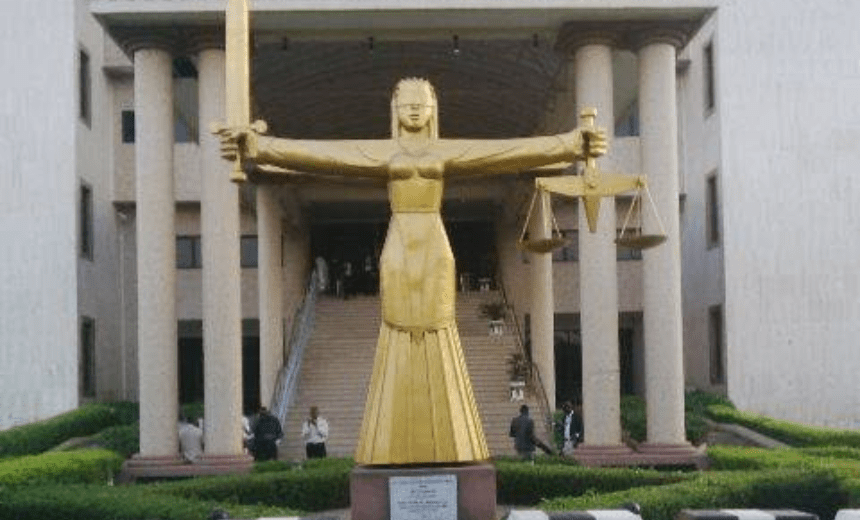
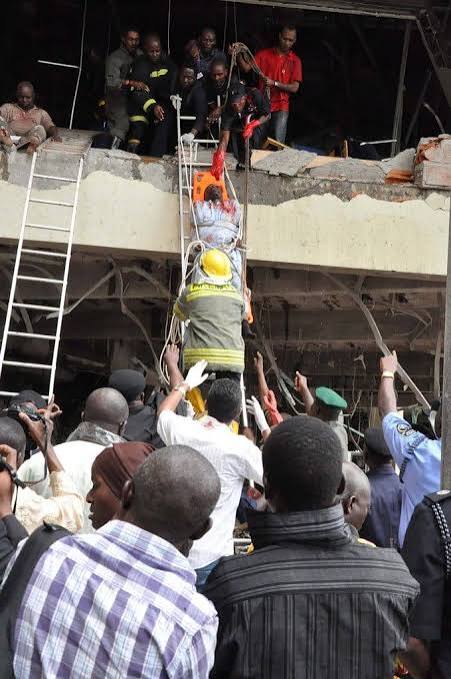
A Federal High Court in Abuja has granted accelerated hearing in the ongoing prosecution of individuals accused of being behind the August 26, 2011, bombing of the United Nations’ building in Abuja.
Justice Emeka Nwite issued the order while ruling on an application moved to that effect by prosecuting lawyer, Alex Izinyon,
Izinyon had noted that the case has been in court for about nine years and prayed the court for expeditious hearing in line with the court’s practice, noting that it is in the interest of all parties that the case be promptly determined by allowing the conduct of proceedings on a daily basis.
The defendants lawyers did not object to Izinyon’s application, prompting Justice Nwite to grant the request.
Al- Barnawi, along with Mohammed Saleh; Umar Bello (aka Datti; Mohammed Salisu) and Yakubu Nuhu (aka Bello Maishayi), are being prosecuted by the State Security Service, SSS.
During proceedings, one prosecution witness, a senior operative of the SSS told the court that the Service was always professional in its investigations, making the assertions while testifying in the trial-within-trial.
The trial-within-trial was being conducted to ascertain whether or not the defendants offered their statements voluntarily.
The witness, identified as PW3, who spoke during cross-examination by lawyer for the second defendant, Bala Dakum, said he couldn’t ⁸recollect the specifics of all that are contained in a video recording of one of the interview session with the second defendant.
The witness, who said he is a computer forensic expert and works in SSS’ Technical Department, told the court that he recorded the interview sessions with the five defendants, but could no longer recall the exact month and year that Exhibit C was recorded, stressing that potable evidential forensic recorders being used by the SSS complies with the Evidence Act and global standards.
The witness faulted Dakum’s claim that there are several skipping in the recording of the statements of the second defendant, Exhibit C, in particular, adding that from the video evidence, he observed that the second defendant was administered the cautionary words and given all the options to volunteer or decline as well as access to legal counsel, but he voluntarily elected to continue with the interview.
On the lawyer’s suggestion that not all the transpired in the interview room was captured in the video, the witness confirmed that all official interaction between the interviewers and defendants was duly recorded.
On why it was only the face of the second defendant that was shown in the video, the witness said it was the standard practice not to capture the faces of the interviewers for their personal safety purpose.
The witness however noted that interviewer often require exchanges, giving papers or pens for the purpose of recording of statements, body part of interviewers may inadvertently become visible, also adding that In the interest of integrity, even such exposure cannot be withheld or tampered with or edited as the recording device is designed to be tamper proof.
On whether a video in which an interviewer’s face is inadvertently captured is either edited or discarded, the witness said every session of official interactions between the defendants and the interviewers are always submitted to the court, noting that where there are concerns bordering on security as a result of inadvertent exposure, such concerns are left for the determination of the court.
Earlier while being cross-examined by lawyer form the first defendant, F. K. Kamaga, the witness gave details of how he audio-visually recorded the interview, statements taken, and translation sessions with the five defendants.
He faulted claim by Kamaga that the recording device could be edited or paused in the course of recording a session.
(Editor: Anoyoyo Ogiagboviogie)