
The United States and Nigeria have concluded the first session of a new Joint Working Group in Abuja, following Washington’s designation of Nigeria as a Country of Particular Concern over religious freedom violations.
The talks come amid mounting international allegations of an ongoing genocide against Christian communities in parts of Nigeria—claims the Nigerian government strongly rejects.
The trip to Abuja was triggered by a rare but consequential move by the United States —that of designating Nigeria a Country of Particular Concern under the International Religious Freedom Act.
The designation cites persistent violence targeting civilians, particularly Christian communities, and alleges failures to adequately prevent or punish attacks by terrorist groups, bandits, and armed militias.
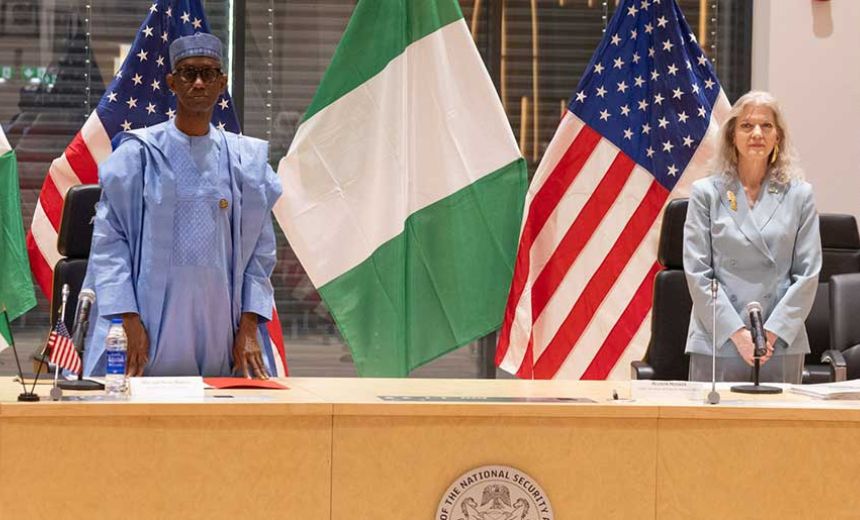
In response, senior officials from both countries convened the first session of the U.S.–Nigeria Joint Working Group, aimed at addressing security, accountability, and religious freedom.
Nigeria’s National Security Advisor, Nuhu Ribadu, led a delegation of ten ministries and agencies, while the U.S. side was headed by Under Secretary of State Allison Hooker, alongside representatives from eight federal agencies.
At the centre of the discussions were allegations by U.S. lawmakers, faith-based organizations, and international advocacy groups that violence in Nigeria’s Middle Belt and northern regions amounts to a genocide against Christians.
The Nigerian government has vehemently rejected the characterization.
Officials insist the violence is not religiously motivated genocide, but rather a complex security crisis driven by terrorism, banditry, criminal militias, and competition over land and resources and affecting Nigerians of all faiths.
Abuja argues that framing the conflict as genocide oversimplifies the problem and risks inflaming sectarian tensions.
MUST READ: GOC 8 Division Visits Ambush Site in Zamfara, Boosts Troop Morale and Operational Readiness
During the talks, Nigerian authorities briefed the U.S. delegation on what they describe as a realignment of military and security resources, particularly in North Central states, and urgent measures to protect at-risk communities, including Christians.
The U.S. delegation welcomed those steps but emphasized the need for sustained action, accountability for perpetrators, and measurable improvements on the ground.
Both governments reaffirmed their commitment to religious freedom, civilian protection, and expanded cooperation on counter-terrorism, intelligence sharing, financial tracking of extremist groups, and law-enforcement capacity building.
While the United States maintained its concerns, the joint statement struck a conciliatory tone—underscoring partnership rather than punishment.
The Working Group is expected to meet again in the United States later this year, as pressure remains on Nigeria to demonstrate concrete progress amid continued scrutiny over the safety of vulnerable religious communities.
The Country of Particular Concern designation allows the United States to impose sanctions or other measures, though officials say engagement and reform remain the preferred path.
Nigeria maintains that protecting all citizens—regardless of faith—remains a top national priority.
(Editor: Ebuwa Omo-Osagie)