
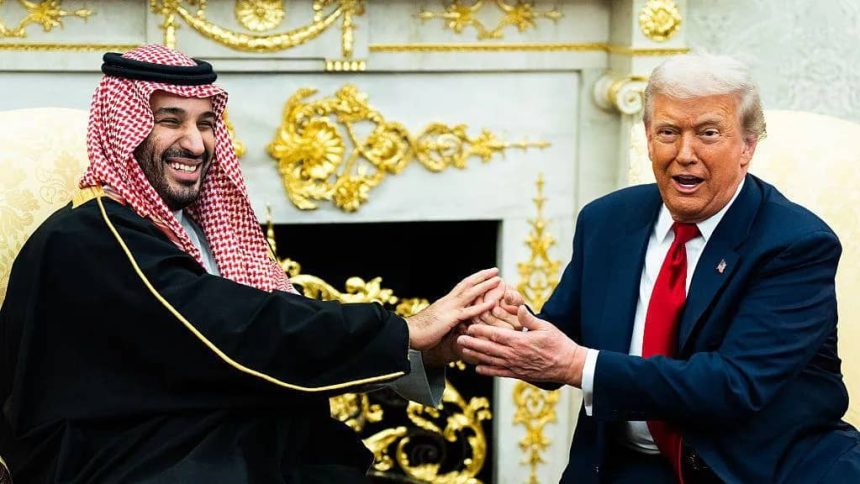
The United States, U.S and Saudi Arabia have signed a landmark deal that will reportedly allow the Gulf kingdom to develop a civilian nuclear programme.
According to the U.S Energy Department, the deal is a “peaceful nuclear co-operation agreement” that will provide “great access for American companies in the Saudi nuclear energy program.”
Text from the deal was not made public, but U.S media have reported that it could allow Saudi Arabia to enrich uranium in the future – which can be used as fuel for power plants, but also to make nuclear bombs.
Experts say that would mark a first for the U.S and could run the risk of future nuclear proliferation in an already unstable region.
The U.S Department of Energy noted that along with the co-operation deal, a “bilateral safeguards agreement” was also signed.
Together, these two agreements lay the legal foundation for a decades-long, multi-billion-dollar partnership that advances several priority economic and strategic objectives, including nuclear nonproliferation,” the statement reads.
The Saudi government also released a statement, saying the deal “represents an extension of existing co-operation between the two countries in the energy sector,” and noted that it comes after the Saudi leader visited Washington last November.
The announcement comes as fighting escalates between the U.S and Iran. Saudi Arabia, a longtime U.S ally, hosts several U.S bases, which have been targeted by Iranian attacks. It also comes two days after Iran’s allies in Yemen, the Houthis, announced a “maritime blockade” against the kingdom.
Specific details of the nuclear deal were not given but earlier media reports suggested that, after undertaking a joint study with the U.S, Saudi Arabia may be allowed to enrich uranium on its soil to produce fuel at a U.S-built enrichment facility, instead of relying on imported fuel.
This could be worth billions of dollars to the U.S, whose companies could be involved in building a facility to produce enriched uranium, which can be used as fuel for power plants but also to make nuclear bombs.
Nuclear experts and former officials in Israel along with the U.S top ally in the Middle East have voiced concern that the plan could ultimately lead to Saudi Arabia being able to develop a nuclear weapon – though many say that path would likely take decades and lead to pushback from the international community.
The director of the Middle East programme at the U.S-based Defense Priorities think tank, Rosemary Kelanic
said it would be “quite shocking” if the deal includes the U.S allowing Saudi Arabia to have facilities to enrich uranium.
The agreement will now be sent to Congress for review. Some lawmakers on both sides of the political aisle are expected to oppose the deal, though Trump’s Republican Party currently controls both the upper and lower chambers.
(Follow AIT News on WhatsApp, AfricaIndependentTV on YouTube, ait_online on Facebook and X (Formerly Twitter), and officialait on TikTok, Instagram and Threads)
(Editor: Terverr Tyav)