
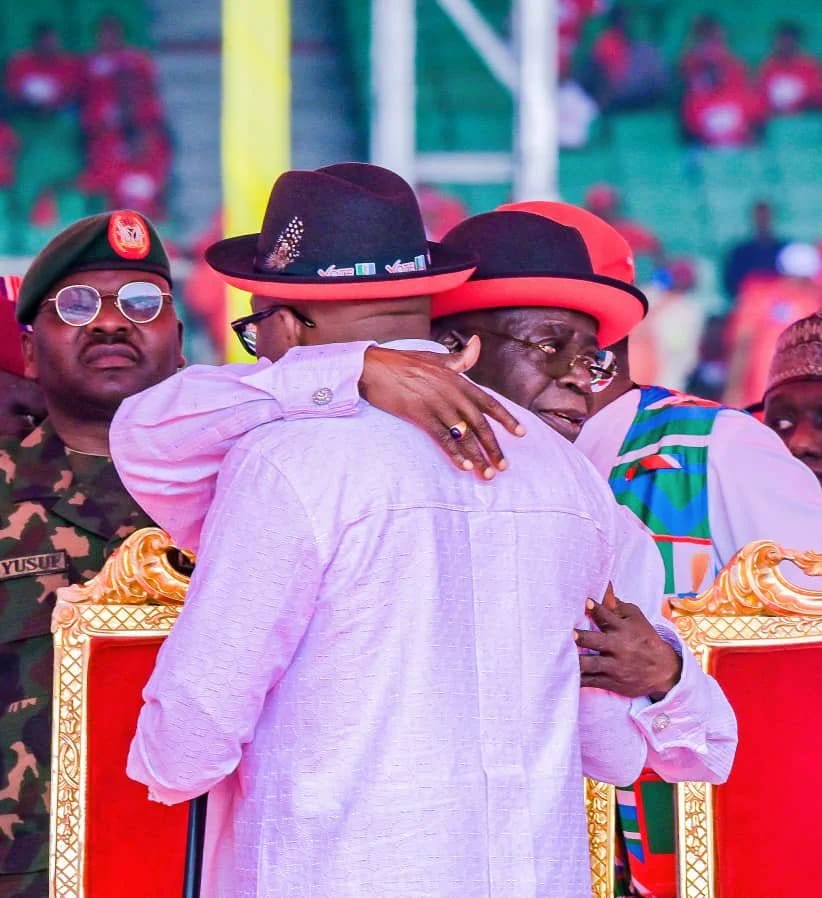
President Bola Tinubu on Saturday publicly commended Rivers State Governor, Siminalayi Fubara, for what he described as his maturity, understanding and commitment to peace in the handling of the protracted political crisis that rocked the state.
The President assured Governor Fubara that he would not regret the sacrifices he has made to restore political stability, declaring that his decision to respect the intervention of elders and embrace reconciliation was appreciated.
But beyond the commendation, President Tinubu’s remarks at the APC presidential campaign rally in Port Harcourt appear to carry significant political implications for the future of Rivers State politics, particularly the relationship between Fubara, the Minister of the Federal Capital Territory, Nyesom Wike, and the emerging political configuration ahead of the 2027 general election.
For a state that has endured more than three years of intense political disagreements, impeachment threats, institutional confrontations and a declaration of emergency rule, President Bola Tinubu’s latest remarks about Governor Fubara represent more than an ordinary expression of appreciation.
They amount to a public acknowledgement of the Governor’s role in the reconciliation process that has gradually reshaped the political landscape of Rivers State.
Speaking at the All Progressives Congress, APC, presidential campaign rally at the Adokiye Amiesimaka Stadium in Port Harcourt, President Tinubu singled out Governor Fubara for commendation, thanking him for accepting the intervention of political elders and choosing the path of peace.
The President’s choice of words is significant, particularly his reference to the crisis as a misunderstanding within the political family.
The disagreement between Fubara and his predecessor, Nyesom Wike, which began shortly after the Governor assumed office in 2023, developed into a major political confrontation over control of the state’s political structure and the Rivers State House of Assembly.
The dispute resulted in divisions within the legislature, repeated impeachment moves against the Governor, legal battles and eventually the declaration of a state of emergency by President Tinubu in March 2025.
Governor Fubara, his deputy, Professor Ngozi Odu, and members of the State House of Assembly were suspended for six months before the emergency rule was lifted in September 2025.
Although subsequent reconciliation efforts brought the contending political camps closer, tensions continued to shape political activities in the state.
It is against this background that Tinubu’s latest intervention and public commendation of Fubara assume particular importance.
First, the President’s remarks could be interpreted as a strong political signal that Fubara’s decision to embrace reconciliation has presidential recognition and backing.
By publicly thanking the Governor and assuring him that he would not regret his actions, Tinubu appears keen to reinforce the political understanding that has brought the previously divided camps together.
It also sends a message to political stakeholders that the President expects the peace arrangement to endure.
Second, the President’s comments have implications for Fubara’s political standing and relationship with the political structure that produced him as Governor.
While Tinubu’s assurance is not a formal guarantee of any future political position, it provides public recognition of Fubara’s role in the reconciliation process and places the President’s personal political authority behind the need to sustain the understanding.
This is particularly important following Fubara’s decision to withdraw from the APC governorship primary, effectively stepping aside from the contest for a second term in the interest of the political settlement.
For a sitting Governor who has had to navigate an extraordinary political crisis, the President’s public acknowledgement may also help consolidate his position within the emerging political arrangement.
Third, Tinubu’s remarks must be considered alongside his equally significant commendation of Nyesom Wike.
The President described the FCT Minister as a development partner of his administration, praising his commitment and contributions to infrastructure development.
This suggests that Tinubu is interested in maintaining a political arrangement that accommodates both influential Rivers State politicians rather than allowing a return to the confrontation that destabilised the state.
The President’s message, therefore, appears to be one of reconciliation without necessarily declaring one political camp the victor.
It is an arrangement in which Fubara is acknowledged for accepting peace, while Wike retains his influence as a key political stakeholder and leader of the Rainbow Coalition.
The implications also extend to the APC and the Rainbow Coalition’s political calculations ahead of the 2027 general elections.
At the rally, Fubara publicly reaffirmed his support for Tinubu’s re-election bid and pledged that Rivers State would deliver no fewer than three million votes for the President.
The Governor also acknowledged Tinubu’s intervention during the state’s difficult political period, describing the President’s involvement as that of a father and statesman who helped prevent the political uncertainty from completely overwhelming the state.
This reciprocal expression of support reinforces the emerging political alliance between the Governor, the Rainbow Coalition and the President’s re-election campaign.
It also demonstrates the strategic importance of Rivers State to the APC’s national political calculations, given its electoral significance in the South-South region.
However, the political implications of the President’s remarks go beyond campaign endorsements and electoral arithmetic.
For Rivers State, the more important question is whether the reconciliation among political leaders will translate into lasting institutional stability, uninterrupted governance and improved delivery of democratic dividends.
The peace arrangement will also be tested by how political interests are accommodated, how disagreements are managed and whether supporters of the different camps genuinely embrace the new understanding.
There is equally the question of what the President’s assurance means for Fubara’s political future beyond his current tenure.
Although Tinubu’s declaration that the Governor will not regret his sacrifice is a powerful political statement, it does not, in itself, resolve questions surrounding future political opportunities, succession arrangements or the distribution of influence within Rivers State APC.
Those issues will ultimately depend on subsequent political negotiations and the decisions of the party’s leadership.
For now, however, Tinubu has made his position on the reconciliation unmistakable: he expects the peace to hold and wants those who accepted the settlement to remain committed to it.
(Follow AIT News on WhatsApp, AfricaIndependentTV on YouTube, ait_online on Facebook and X (Formerly Twitter), and officialait on TikTok, Instagram and Threads)
Editor: Terverr Tyav