
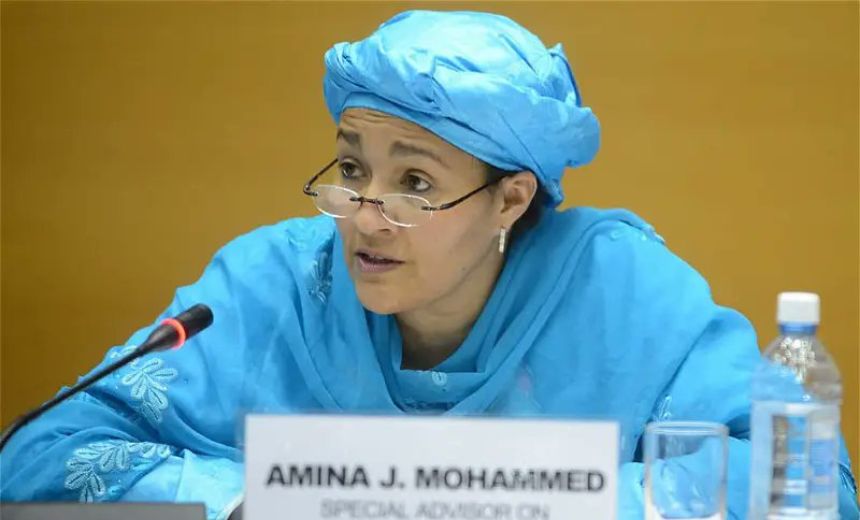
The United Nations Deputy Secretary-General, Amina Mohammed, has presented the Secretary-General’s report on the funding and governance of the UN Resident Coordinator System to the Fifth Committee, chaired by Nigeria’s Permanent Representative to the United Nations, Ambassador Jimoh Ibrahim.
The presentation forms part of the proposed UN Programme Budget for 2027.
Receiving the report at the 81st Session of the General Assembly, Ambassador Ibrahim assured the Deputy Secretary-General that the Fifth Committee would give the proposal due consideration, stressing that the eight years of achievements recorded by the system would not be overlooked.
Addressing the financial implications of the proposed budget, Ambassador Ibrahim emphasised that a fundamental principle of finance is that the return on investment must be higher than the cost of capital, noting that the same principle should guide the United Nations in creating value through its spending.
He also underscored the need for adequate funding of the Resident Coordinator System, particularly securing sufficient resources to cover at least 70% of staff costs, stressing that staff funding is essential to the system’s effectiveness.
In her presentation, Amina Mohammed described the Resident Coordinator System, established in 2018 through General Assembly Resolution 72/279, as one of the most significant structural reforms of the United Nations.
She said the system had become a cornerstone of the UN development architecture, bringing together agencies, expertise and resources to support countries in achieving the Sustainable Development Goals.
Highlighting its impact, the Deputy Secretary-General disclosed that the system coordinates more than $20 billion in annual UN development programming across over 160 countries and territories, while supporting more than 1,500 inter-agency coordination groups.
She disclosed that the Secretary-General is proposing that recurring staff positions be financed through assessed contributions under the UN regular budget, rather than relying heavily on voluntary contributions and the existing levy mechanism.
According to her, the funding gap would have reached approximately $99 million in 2025 without temporary financial support, while the projected gap for 2026 stands at about $132 million.
She stressed that a properly funded and strengthened Resident Coordinator System would be essential to implementing the broader UN80 reform agenda, warning against further delays in addressing its funding challenges.
The Secretary-General’s proposal is now before the Fifth Committee, which is responsible for the administrative and budgetary matters of the United Nations.
The deliberations place the Committee, under Nigeria’s chairmanship, at the centre of discussions on the financial future and institutional effectiveness of the UN development system, further highlighting Nigeria’s role in steering critical budgetary decisions.
(Follow AIT News on WhatsApp, AfricaIndependentTV on YouTube, ait_online on Facebook and X (Formerly Twitter), and officialait on TikTok, Instagram and Threads)
(Editor: Terverr Tyav)