
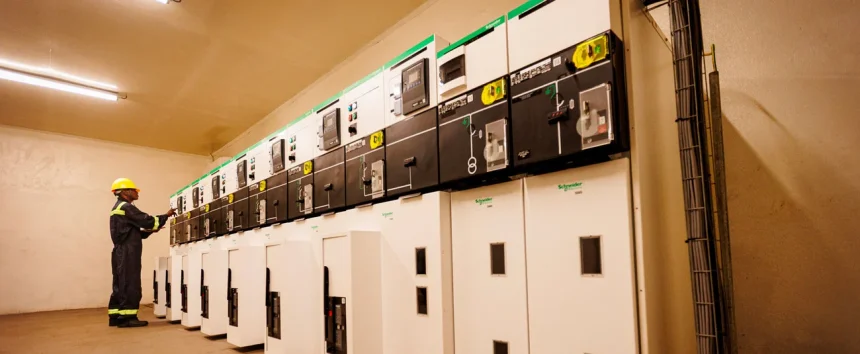
In April 2024, at the World Bank Group-International Monetary Fund annual meetings held in Washington, D.C., Group President and the African Development Bank, AfDB launched “Providing Access to Electricity for 300 Million People in Africa by 2030.”
A statement Issued on Wednesday at the sidelines of the 2026 AfDB annual meeting in the Republic of Congo, Brazzaville, and sgned by African Regional Organisation of the International Trade Union Confederation, ITUC-Africa, Public Services International, PSI, and IndustriAII Global Union Sub-Saharan African Region, said Africa on behalf of African workers and their trade unions especially those in the energy sector affiliates in Africa are deeply concerned that “Mission 300” marks a continuation of the neoliberal approach to electrification.
The global labour unions say the policies proposed under “Mission 300” are almost identical to the AfDB’s New Deal on Eneray for Africa initiative, that was launched a decade ago.
They say the New Deal pledged to mobilise private investment to achieve 100% access in urban areas and 95% access in rural areas by 2025, and with 50% of sub-Saharan Africans still without electricity at the beginning of 2026 or roughly 600 million people, the New Deal was a spectacular
failure.
The ITUC-Africa, PSI African office and industriALL argued in the statement that
“Mission 300” likely faces a similar fate because it also relies on “crowding in” private investment by creating “bankable projects” for private interests.
They say the World Bank Group and the AfDB have pledged to mobilise $48 billion concessional financing, but this financing will be contingent upon governments using the finance to “de-risk” the
investments of private companies. This, the global labour unions believe, is both untenable and unjust.
The World Bank’s own studies estimate
that the financing gap for Sub-Saharan Africa to reach the SDG 7 goal of 100% access, is in the region of US$35 billion to US$50 billion annually, or between US$175 to US$350 billion over the five year period. While the World bank group maintains that the private sector is ready to make these investments, although it will “require significant subsidies with amounts in the range of 50% of the total capital expenditures.
The ITUC-Africa which represents over 18 million workers across 52 African
countries, the Public Services International Global Union Federation for public service workers, uniting 700 trade unions with 30 million members in more than 150 countries and IndustriAII Global Union Sub-Saharan African Region, a Global Union Federation for
the extractive, energy and manufacturing workers, uniting 12 million workers in 33 Sub-Saharan countries, used the statement to ask the AfDB to seriously re-think its assumptions about relying on the private sector to lead Africa’s electrification, especially when it involves large amounts of borrowing, the burden of which will fall on the shoulders of governments already struggling to service their existing debts.
The global labour unions say they are equally concerned that the African Union, A.U., at its 38th Summit in Addis Ababa in February 2025 adopted “Mission 300” seemingly without any serious questions being
asked, as did the G20 Leaders’ Summit Declaration following its meeting in Johannesburg last November.
The workers group argued further that In its endorsement, the A.U reiterated that governments “recognise that the private sector needs to play a central and determinant role …therefore creating an enabling environment
for private sector investment is critical.”
The A.U. believes that regulations supportive of
private capital, accompanied by “appropriate incentives and innovative financing
mechanisms” are necessary, and it is committed to push reforms to make power utilities “financially viable” by way of “tariff adjustments and efficiency improvement measures ensuring utilities achieve at least 100% operational cost recovery.”
As unions representing energy sector workers, the ITUC-Africa, PSI and IndustriALL say they have a close-up view of what “100% operational cost recovery” means in practice. That is, Public utilities become so financially stressed that they are unable to improve or expand the infrastructure necessary for electrification.
ITUC-Afica, IndustriAll and PSI’s power sector affiliates urge the World Bank Group and the African Union, which is part of the G20, to adopt what they and other
trade union bodies call a Reclaim & Restore (R&R) alternative to addressing the lack of access to electricity. According to the unions, this approach focuses on providing adequate financial and technical support for public utilities so that they can pursue electrification goals in a planned and
orderly way.
In terms of advancing a just energy transition, the unions encourage the Bank and the A.U. to take a close look at Mexico’s decision to rebuild its public utility and to assign to it a range of
energy transition responsibilities, including the expansion of transmission and distribution infrastructure, the deployment of publicly owned renewable energy, and the allocation of
final investment decisions to the government, not risk-averse independent power producers, IPPs, whose main priority is to secure returns on investment.
The uniins added that the Bank acknowledges that the utilities are the “weakest link” in the energy transition in Africa. The current policy makes that link weaker still in order to create space for the private sector, currently, reclaim & restore: rejects “full cost recovery” as a measure of utilities’ viability. They say the Bank and the development finance community must recognise the potential role of power utilities in reaching electrification goals within a public pathway framework for energy transition, insisting that power utilities in Africa be de-marketised; and financial and technical
support for private independent power producers (IPPs) should be redirected towards public utilities aimed with an electrification mandate.
The unions further propose that African governments repeal the neoliberal privatisation laws
introduced by the World Bank and the IMF during the 1980s and 1990s during the
period of structural adjustment, noting that they are convinced that “Mission 300” will not be able to deliver on its 300 million target by 2030 based on the current set of policies. And any electrification that might occur in the coming years will impose an intolerable debt burden on governments, as public money is used to subsidise the profits of energy companies, many of which are multinationals based
outside of Africa.
They say further that as part of the World Bank’s 2026 evaluation, they are ready to explain, further discuss, and
otherwise engage the advantages of the R&R approach to electrification, while ensuring the wellbeing and livelihoods of 600 million Africans without electricity is their priority.
(Editor: Terverr Tyav)