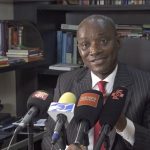



The Secretary to the Government of the Federation, George Akume, has charged tertiary institutions to match greater federal investment in education with greater accountability, prompt utilisation of funds and measurable impact on teaching, research and graduates.
Akume gave the charge on Wednesday in Abuja during the 2026 TETFund Town Hall Dialogue with Stakeholders.
The SGF was represented at the event by Pharm. Aliyu Zakari-Jiya.
Describing tertiary education as national development infrastructure, the SGF said Nigeria’s greatest natural resource is not only what lies beneath the soil but also what sits in its classrooms, laboratories, workshops and libraries.
“Nigeria’s greatest natural resource is not only what lies beneath our soil. It is also what sits in our classrooms, our laboratories, our workshops and our libraries… the talent, curiosity and enterprise of the Nigerian people,” Akume said.
He stressed that education must not be seen as one sector competing with roads, power or health, but as the conveyor belt that produces the engineers who build roads, the scientists who improve agriculture, the doctors who protect health and the innovators who will create future industries.
According to him, investment in tertiary education is investment in productivity, competitiveness, social mobility and national resilience. He added that the core question stakeholders must ask is: “What national capability has Nigeria created through our investment in tertiary education?”
Akume said TETFund’s statutory mandate covers physical infrastructure, instructional materials and equipment, research and publication, and academic staff training and development, with requirements for monitoring, evaluation and audited reporting.
He warned that tertiary institutions would not succeed with buildings alone.
“This understanding is important because there is no modern university, polytechnic or college of education that will succeed with buildings only. Research, well-equipped workshops and knowledge development infrastructure for training teachers must be present,” he said.
He noted that TETFund investment had become phenomenal under President Bola Ahmed Tinubu and that this brought both opportunity and responsibility. The return on investment, he said, must be measured not simply by buildings erected, but by better teaching, scholarship, governance and graduates.
The SGF called for reforms to ensure that postgraduate training strengthens Nigerian institutions, research moves from the laboratory to the marketplace and informs public policy, and institutions share costly facilities to produce more patents, licences, start-ups and solutions to national problems.
He also emphasised the student experience, including accommodation, reliable power, connectivity, laboratories, libraries and safe campuses.
Raising a major concern, Akume disclosed that reports available to his office showed that some institutions had delayed accessing allocations already made available to them.
“This self-inflicted challenge could be overcome if boards and governing councils make oversight, maintenance and measurable impact central to their stewardship,” he said, urging institutions to access funds promptly, deliver projects properly, maintain what has been built and report what investments achieve.
He gave assurances that the administration would protect predictable investment in tertiary education and ensure that TETFund complements, rather than substitutes for, the responsibilities of institutional proprietors, while building stronger partnerships with industry, alumni, students and civil society to commercialise research, support scholarships, protect public assets and hold all stakeholders accountable.
“The ultimate measure of TETFund’s impact will be the capability Nigeria builds. Let us build institutions worthy of Nigeria’s ambition and human capital equal to Nigeria’s promise,” Akume concluded.
(Follow AIT News on WhatsApp, AfricaIndependentTV on YouTube, ait_online on Facebook and X (Formerly Twitter), and officialait on TikTok, Instagram and Threads)
Editor: Ada Ononye