


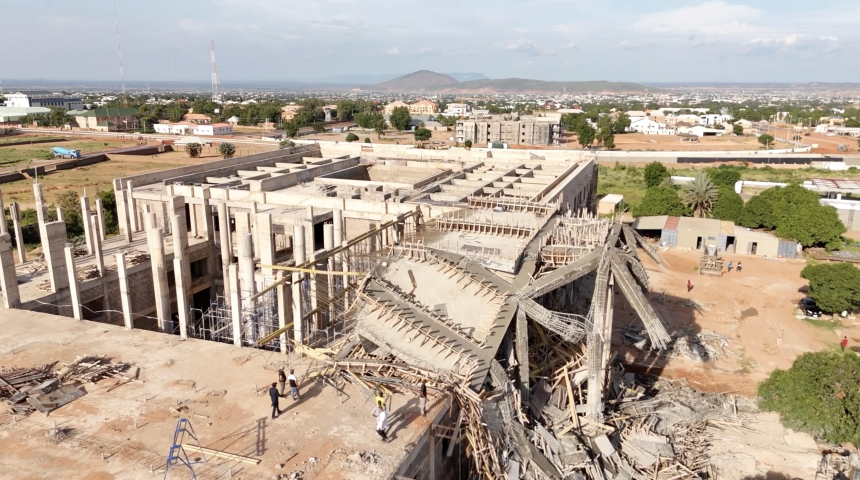
It is nearly three months since a section of the entrance canopy at the ongoing Gombe State House of Assembly Complex collapsed during construction, killing one worker and injuring seven others.
Today, the Council for the Regulation of Engineering in Nigeria, COREN, has released its findings, blaming the incident largely on construction procedures and inadequate temporary support — not faulty design or materials.
The panel has also cleared the standing structure for construction to resume.
On July 10, tragedy struck the construction site of the new Gombe State House of Assembly Complex.
A section of the cantilevered entrance canopy collapsed while fresh concrete was being placed, killing one worker and injuring seven others.
The injured were evacuated to the Gombe State Specialist Hospital and the Federal Teaching Hospital.
Nearly three months later, COREN’s eight-member investigation panel has presented its findings to the state government.
The panel examined the design, reinforcement, concrete strength, working drawings, construction sequence and temporary support arrangements.
It found the design and materials technically sound, but raised concerns about the execution of the work and the absence of properly registered professionals on site.
“The contractor has not employed the services of registered relevant professionals on the project.”
COREN says it has carried out integrity tests on the standing structure and has cleared it for work to continue.
“We carried out what we call integrity check on the standing structure after the collapse and we found out they are adequate — and the construction can continue.”
Receiving the report on behalf of Governor Inuwa Yahaya, the Deputy Governor Manassah Jatau says, state government deliberately kept the site open for a transparent technical investigation.
“We have exposed it to all technical processes to do a thorough analysis and tell us what happened.”
He says the recommendations will be implemented, with tighter supervision as construction resumes.
But for COREN, the incident carries a wider lesson — the need for proper mentorship and supervision of young engineers.
“Only graduating from university is not enough. After graduation, you have to understudy somebody for a certain period of time — about three to four years — before you are given a licence to start practicing.”
The council also says government must ensure engineering contracts are handled by properly licensed professionals.
For Gombe, construction may now resume — but under stricter professional oversight.
(Follow AIT News on WhatsApp, AfricaIndependentTV on YouTube, ait_online on Facebook and X (Formerly Twitter), and officialait on TikTok, Instagram and Threads)
Editor: Nkoli Omhoudu