

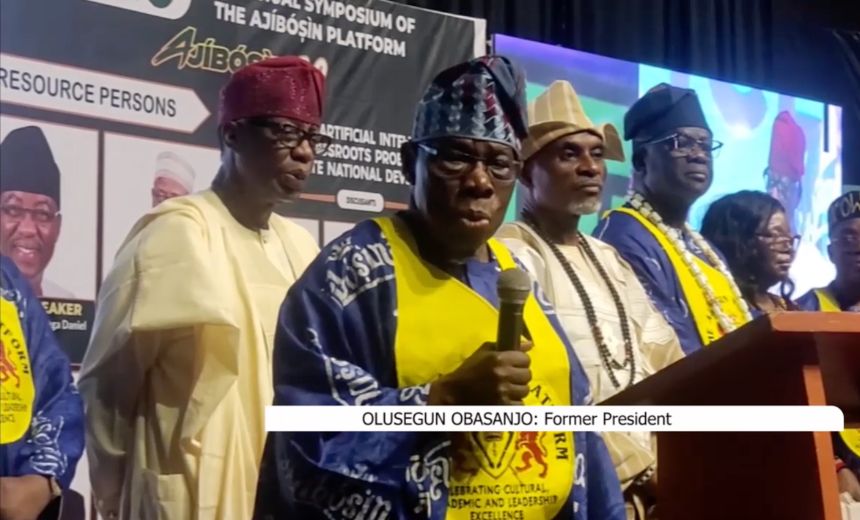
Former President, Olusegun Obasanjo has criticised President Bola Tinubu’s position on government borrowing, describing excessive debt as an economic threat for generations.
Obasanjo, who explained that debt was worse than leprosy, said borrowing without adequate consideration of its long-term consequences could mortgage the future of the country.
The former President made the remarks at a symposium in Abeokuta, organised to explore how Artificial Intelligence, AI could be deployed to address grassroots challenges and accelerate national development.
President Tinubu had, in April, defended his administration’s borrowings, arguing that loans should not be viewed negatively as long as the government had the capacity to repay them.
But Obasanjo strongly disagreed with that position, describing it as a misnomer and not in the overall interest of the people.
He also questioned Nigeria’s economic progress over the decades, recalling that when he established his farm 47 years ago, the naira exchanged at N1 to $1 and 85 cents.
MUST READ: AIG Demands More Vehicles, Others To Secure Calabar Carnival, Elections
Obasanjo challenged the country’s political leadership to account for the dramatic depreciation of the Naira, which he said now exchanges at about N1,500 to $1.
Also speaking at the symposium, guest speaker and historian, Dr. Umar Ardo, raised concerns over Africa’s growing dependence on foreign technology, warning that AI could deepen the continent’s vulnerability if it fails to take ownership of its digital infrastructure.
Ardo stressed the need for strategic investments in semiconductor manufacturing, data centres and African-owned datasets, alongside stronger continental cooperation.
He warned that without deliberate efforts to build indigenous technological capacity, Artificial Intelligence could become another instrument through which foreign powers manage Africa’s affairs, rather than a tool for empowering the continent to shape its own future.
The symposium underscored the need for responsible economic management and technological independence as critical pillars for Nigeria’s and Africa’s sustainable development.
(Follow AIT News on WhatsApp, AfricaIndependentTV on YouTube, ait_online on Facebook and X (Formerly Twitter), and officialait on TikTok, Instagram and Threads)
(Editor: Terverr Tyav)