


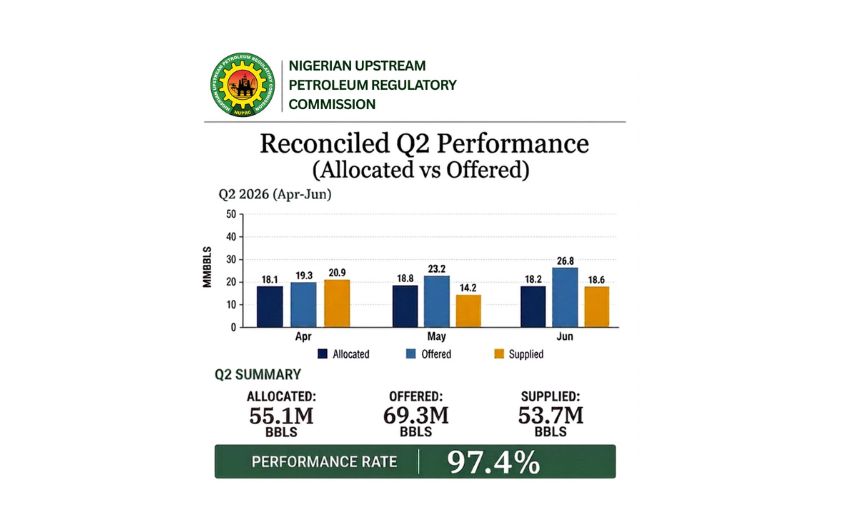
Cue: A fresh report by the Nigerian Upstream Petroleum Regulatory Commission, NUPRC, shows that more than 53 million barrels of crude oil and condensate were supplied to Nigerian refineries between April and June 2026.
The Commission says the development represents 97.4 percent performance under the Domestic Crude Supply Obligation, DCSO.
For motorists, transport operators, manufacturers and millions of Nigerians whose daily activities depend on petroleum products, the availability of crude for domestic refining remains a critical part of the country’s energy story.
The latest figures from the Nigerian Upstream Petroleum Regulatory Commission indicate that the supply of crude to local refineries remained relatively strong in the second quarter of 2026.
A total of 53.7 million barrels of crude oil and condensate were supplied to local refiners between April and June, representing an overall Domestic Crude Supply Obligation
DCSO performance of 97.4 percent.
The Domestic Crude Supply Obligation is the framework through which oil producers are required to make specified volumes of crude available to licensed domestic refineries under the Petroleum Industry Act.
In April, producers supplied 20.9 million barrels against an allocation of 18.1 million barrels, representing 114.9 percent performance.
Supply dropped in May, when 14.2 million barrels were eventually delivered against an allocation of 18.8 million barrels, representing 75.8 percent compliance.
By June, however, performance improved, with 18.6 million barrels supplied against an allocation of 18.2 million barrels, representing 102.4 percent performance.
The Commission attributes the improvement partly to increased local oil production and the signing of long-term crude supply agreements backed by bankable Sales and Purchase Agreements between producers and domestic refiners.
But the figures also reveal an important part of the domestic refining story.
The Dangote Refinery indicated a requirement for about 63 million barrels of crude during the quarter, while producers offered about 68.1 million barrels.
Despite the higher volume offered, the refinery eventually accepted 52.6 million barrels, about 78 percent of the crude offered to it.
This reflects the “willing buyer, willing seller” principle under the DCSO framework, meaning that while producers are expected to make crude available, the final transaction is also influenced by the willingness of refiners to purchase the crude.
For Nigerians, the significance goes beyond the statistics.
A stronger domestic crude supply system could support increased local refining, reduce reliance on imported petroleum products and strengthen the country’s drive towards energy sufficiency.
The NUPRC says it remains committed to sustaining recent gains in crude oil production while continuously enforcing the Domestic Crude Supply Obligation.
(Follow AIT News on WhatsApp, AfricaIndependentTV on YouTube, ait_online on Facebook and X (Formerly Twitter), and officialait on TikTok, Instagram and Threads)
(Editor: Nkoli Omhoudu)